Three years ago, CMS changed how many physician-administered drugs approved under the FDA’s 505(b)(2) pathway are billed. The market is still catching up. Now a second, more disruptive wave is arriving: the first true generics of those 505(b)(2) products, filed as ANDAs, are reaching the market.
The result is a coding problem that many payers, providers, and claims systems were never designed to handle.
How We Got Here: The First Wave
The 505(b)(2) pathway allows a sponsor to rely on existing safety and efficacy data while introducing a change to an existing drug, such as a new formulation, delivery method, dosing regimen, or excipient. Unlike an ANDA, a 505(b)(2) product does not have to demonstrate therapeutic equivalence to its reference listed drug (RLD).
That distinction became important for reimbursement. In late 2022, CMS revisited how it assigns HCPCS Level II codes to 505(b)(2) products. Because these products are not therapeutically equivalent to their reference drugs, CMS began treating them as single-source drugs eligible for their own J-code and ASP-based payment rate rather than sharing a code and blended payment rate with the RLD and its generics.
CMS issued 36 new HCPCS codes for these products in its Q3 2022 cycle, effective January 1, 2023, and indicated it would continue reviewing additional 505(b)(2) products.
That was the first wave: 505(b)(2) products carving out their own J-code, ASP, and reimbursement profile. Practices, payers, and claims processors spent the next several years relearning drug catalogs one code at a time, often after a denial or payment discrepancy exposed the issue.
The Second Wave: Generics Chasing a Moving Target
Now the problem is getting more complicated. The 505(b)(2) products approved since 2022 can themselves become RLDs for future ANDA filings, and those ANDA generics are beginning to reach the market.
On paper, this is exactly how the system should work. An ANDA sponsor references an approved RLD, demonstrates bioequivalence, and brings lower-cost competition to market.
The problem is that the RLD may itself be a 505(b)(2) product with a different regulatory and reimbursement identity than the original innovator drug.
A Live Example: Romidepsin
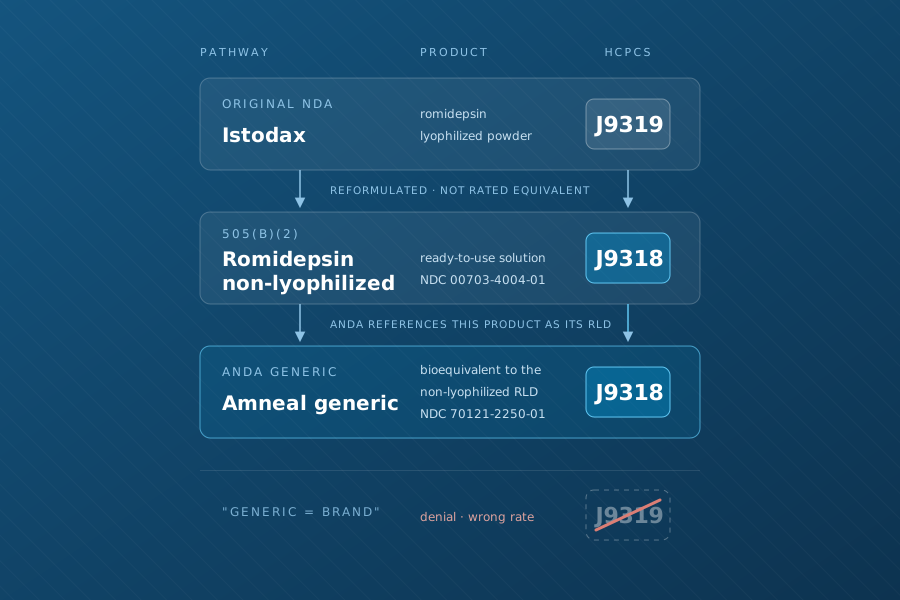
One molecule, three regulatory identities:
| Identity | HCPCS | Product |
|---|---|---|
| Original NDA | J9319 | Istodax, lyophilized. Injection, romidepsin, 0.1 mg. |
| 505(b)(2) | J9318 | Ready-to-use, non-lyophilized. Reformulated and not rated therapeutically equivalent, so CMS assigned a separate single-source code and ASP. NDC 00703-4004-01. |
| ANDA generic | J9318 | Amneal, NDC 70121-2250-01. References the 505(b)(2) product as its RLD, not the original, so it bills under J9318, not J9319. |
A biller working from the drug name alone has no obvious way to know that the Amneal product maps to J9318 rather than J9319, or that its reimbursement relationship is tied to the 505(b)(2) RLD.
Multiply this across the growing number of 505(b)(2) oncology and specialty injectables, and the crosswalk problem becomes clear.
A provider or biller may need to determine whether a product is the original brand, the 505(b)(2) product with its own J-code, or an ANDA generic referencing that 505(b)(2) product. Each can have a different HCPCS code, ASP, and payer coverage rules, yet that regulatory lineage is rarely obvious from the drug label, wholesaler portal, or EHR.
Four Structural Gaps Make This Worse
- No centralized crosswalk. Neither FDA nor CMS provides a centralized, user-friendly resource showing which products were approved under 505(b)(2) or which ANDA generics reference those products as their RLD.
- Vague code descriptors. HCPCS descriptions often identify only the route and chemical name. Manufacturer information in newer descriptors does not fully solve the problem when the same manufacturer markets both 505(b)(2) and ANDA products involving the same drug.
- Systems assume one code per drug. EHRs, prior authorization systems, and wholesaler portals are generally not designed to distinguish multiple codes for products that appear to be the same drug.
- Generic does not always mean interchangeable. The 505(b)(2) RLD is not therapeutically equivalent to the original innovator product, while the new ANDA is only bioequivalent to the 505(b)(2) RLD. A simple “generic = substitute for brand” assumption can therefore produce the wrong result.
Why This Hits Every Stakeholder Differently
Providers and infusion centers
They carry the immediate financial risk. Billing the wrong J-code for a high-cost physician-administered drug can result in a denial, clawback, or reimbursement at the wrong rate.
Payers
Prior authorization, step therapy, and formulary rules built around a legacy code may need to account for multiple related codes with different regulatory and reimbursement profiles.
Claims processors and clearinghouses
They must reconcile NDC-to-HCPCS crosswalks with a code system that does not explicitly capture regulatory lineage. The correct code may depend on the specific NDA or ANDA associated with the product administered, information that is often not obvious from the claim itself.
Where This Goes From Here
The number of 505(b)(2) products carrying unique J-codes has grown since 2023, and more ANDA sponsors are filing against those products as RLDs.
Without better product-level identification, the industry risks repeating the miscoding, underpayment, and appeals problems of the first wave, now across two generations of related products.
The solution is operational: a reliable way to trace an NDC or product name through its regulatory lineage, from the original NDA to the 505(b)(2) RLD and any ANDA generics that reference it, and then connect that lineage to the correct HCPCS code and current ASP.
That is the gap BuyandBill.com is built to address. Alchemy Healthcare Solutions tracks J- and Q-code assignments, detailed NDC information, and ASP data across buy-and-bill drugs, allowing us to identify 505(b)(2)-to-ANDA relationships as they emerge rather than after they become denials.
For manufacturers, that means getting ahead of payer confusion with clear billing and coding guidance at launch. For providers and payers, it means having a source that connects a drug’s regulatory lineage to the code that should appear on the claim, rather than reverse-engineering the answer one denial at a time.
Trace the code before it becomes a denial The BuyandBill.com pricing app has ASP, WAC, and AWP pricing, NDC-to-HCPCS crosswalks, billing units, administration rates, and real-world claims data. Search by NDC, HCPCS, or drug name at pricing.buyandbill.com.
Frequently Asked Questions
What is a 505(b)(2) drug?
A 505(b)(2) product is a drug approved through an FDA pathway that allows the manufacturer to rely, in part, on existing safety and efficacy data. This can make it possible to bring a modified version of an existing drug to market, such as a new formulation, delivery method, dosage, or excipient.
Unlike a traditional ANDA generic, a 505(b)(2) product does not have to be therapeutically equivalent to the original drug.
Why do 505(b)(2) drugs have their own J-codes?
CMS began treating 505(b)(2) products as single-source drugs in late 2022 because they are not therapeutically equivalent to their reference drugs. That means they can receive their own HCPCS code and ASP-based payment rate instead of sharing a code and blended payment rate with the reference drug and its generics.
The first 36 of these codes became effective January 1, 2023.
Can a generic reference a 505(b)(2) drug?
Yes. A 505(b)(2) product can become the reference listed drug (RLD) for an ANDA generic.
In that case, the generic is considered bioequivalent to the 505(b)(2) product, not to the original innovator drug. For Medicare Part B billing, the generic uses the HCPCS code assigned to the 505(b)(2) product, rather than the code for the original brand.
How do I find the right HCPCS code for a generic of a 505(b)(2) drug?
Start with the generic's NDC and trace it back to its reference listed drug (RLD). Once you identify the 505(b)(2) product the ANDA references, use the HCPCS code assigned to that product.
Our free NDC Lookup shows the HCPCS code and billing units associated with an NDC. Our 505(b)(2) Drugs page tracks the 505(b)(2) products that have their own HCPCS codes.