Reimbursement guide
Buy-and-Bill Drug Billing and Coding
A practical overview of the codes, pricing benchmarks, and payer systems behind getting physician-administered drugs reimbursed.
What is buy-and-bill?
Buy-and-bill is the purchasing and reimbursement model used for drugs that a clinician administers rather than a patient taking at home. The practice purchases the drug up front, keeps it in inventory, administers it to the patient, and then bills the payer for the drug and its administration.
Because the provider purchases and takes ownership of the drug, these claims are generally covered under the medical benefit rather than the pharmacy benefit. For Medicare, that typically means Part B rather than Part D. The drug is billed using a HCPCS code and billing units, while the administration is billed separately using a CPT code. Buy-and-bill is common in oncology, rheumatology, ophthalmology, and hospital outpatient infusion.
-
Purchase
The practice buys the drug up front from a wholesaler, specialty distributor, or other supplier and holds it in inventory until it is needed for a patient.
-
Administer
A clinician administers the drug in the office, clinic, or hospital outpatient department. It may be an infusion, injection, or implant. The patient does not take the drug home.
-
Bill
After administration, the practice submits a claim for the drug and its administration. The drug is reported using a HCPCS code and billing units, while the administration is reported using the appropriate CPT code.
-
Get reimbursed
The payer reimburses the practice after the claim is processed. Until payment arrives, the practice has already paid the acquisition cost of the drug, making accurate coding and reimbursement a cash-flow issue, not just a clerical one.
Buy-and-bill versus white and brown bagging
The alternatives to buy-and-bill all move drug purchasing away from the practice. Who buys the drug decides who bills for it and which benefit pays.
Buy-and-bill
This page
- Who buys the drug
- The provider
- Who bills
- The provider
- Which benefit pays
- Medical benefit (Medicare Part B)
White bagging
Alternative
- Who buys the drug
- A specialty pharmacy
- Who bills
- The pharmacy
- Which benefit pays
- Pharmacy benefit
Brown bagging
Alternative
- Who buys the drug
- A pharmacy, dispensed to the patient
- Who bills
- The pharmacy
- Which benefit pays
- Pharmacy benefit
The distinction matters commercially as well as clinically: under buy-and-bill the practice carries the acquisition cost and the inventory risk, and recovers both only if the claim is coded and paid correctly.
How a buy-and-bill claim is built
Drug reimbursement is handled electronically, and standardized codes allow payers to process claims and payments. A single administered dose can involve several different code sets, each serving a different purpose. Each code set is maintained by a different organization and provides specific information the payer needs to determine how the drug and its administration should be processed and reimbursed.
Anatomy of one claim line: 420 mg of trastuzumab, infused
HCPCS drug code
A J, Q, C, or NOC code identifies the product itself. This one is trastuzumab, and like every drug code it carries a defined billing unit rather than a package size.
Look up a HCPCS drug codeBilling units
The billing unit defines how much drug one unit represents. Here it is 10 mg. Units are where most drug claims go wrong, because the code describes a fixed amount that rarely matches the vial size or the dose given.
Convert a dose into unitsNDC package code
The 11-digit NDC identifies the exact package administered. Payers use it to confirm the drug behind the HCPCS code, and a mismatch between the two is a common denial.
Look up an NDCCPT administration code
A separate procedure code reports how the drug was given: IV infusion, IV push, subcutaneous or intramuscular injection, or chemotherapy administration. It is billed alongside the drug, not instead of it.
Browse administration codesICD-10-CM diagnosis code
The diagnosis establishes medical necessity. Coverage policies frequently limit a drug to specific indications, so the diagnosis on the claim has to support the drug being billed.
See coverage and policy termsModifiers
Modifiers qualify the line. JW reports the discarded portion of a single-dose vial and JZ attests that nothing was discarded; one of the two is required on most single-dose drug claims.
JW and JZ wastage guidanceHow buy-and-bill drugs are paid
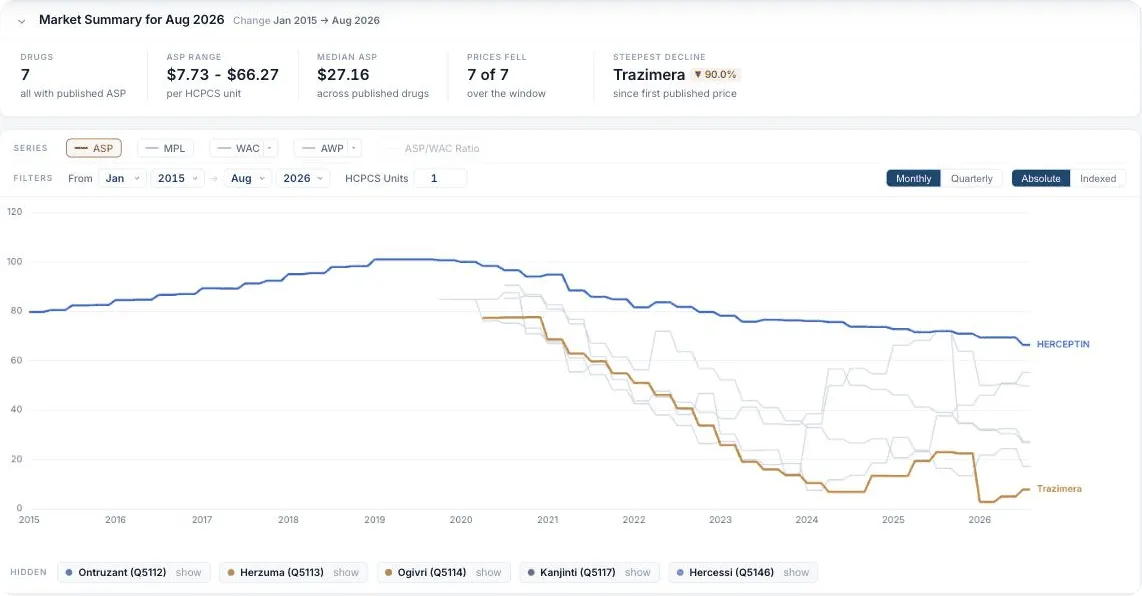
For most separately payable drugs covered under Medicare Part B, Medicare sets the payment limit at the average sales price (ASP) plus 6 percent. CMS publishes these payment limits quarterly for each HCPCS billing unit. Medicare generally pays 80 percent of the allowed amount, with the patient responsible for the remaining 20 percent as coinsurance.
Two adjustments regularly surprise practices when reconciling a remittance. First, federal sequestration reduces Medicare's payment by 2 percent. The reduction comes out of Medicare's share rather than the patient's, so the Medicare payment is slightly less than 80 percent of the payment limit. Second, some drugs do not have a published ASP, for example newly approved products or drugs billed under unclassified codes. In those cases, Medicare may use another methodology, such as WAC-based pricing or invoice-based pricing, depending on the drug and applicable CMS rules.
Where buy-and-bill claims go wrong
Billing and coding errors can lead to claim denials, delayed or reduced payments, and compliance exposure. Because the practice has already paid for the drug, a denied claim puts the practice's acquisition cost at risk while payment is delayed or disputed. These are the failure points worth checking first.
-
Billing unit miscalculations
The HCPCS billing unit almost never equals one vial. Converting the administered dose into the correct number of billing units is one of the most common sources of over- and under-billing on drug claims.
Run the numbers -
Units above the MUE limit
Medically Unlikely Edits (MUEs) establish the maximum number of units that are typically payable for a given HCPCS code on a single date of service. Exceeding an MUE can cause the line to deny, and some MUEs cannot be bypassed with a modifier.
Check MUE limits -
Inactive or mismatched NDCs
An NDC that is inactive, discontinued, repackaged, or not correctly loaded in the payer's system can cause a claim to deny even when the HCPCS code is correct.
How NDC listing errors happen -
Unreported drug wastage
When drug is discarded from a single-dose container, the unused amount may be separately payable when reported correctly. JW identifies discarded drug, while JZ indicates that there was no discarded amount.
Wastage guidance -
Self-administered drug exclusions
Medicare generally does not pay under Part B for drugs that its contractors determine are usually self-administered. These determinations are made by individual Medicare Administrative Contractors (MACs), so the applicable exclusions can vary by jurisdiction.
SAD exclusion list
For manufacturers
Buy-and-Bill Drug Launch Fundamentals
The first year after approval is critical to establishing a drug's buy-and-bill reimbursement pathway. Manufacturers need to coordinate NDC listing, HCPCS coding, Pass-Through Status, pricing data, and payer system updates so the product can be correctly identified and reimbursed.
Key launch milestones
NDC listing
Major pricing compendia, including Red Book, Medi-Span, and First Databank (FDB), provide the pricing and product data that payers use to identify and price drugs. Manufacturers should verify that product information, NDCs, WAC, AWP, and brand/generic status are accurate and consistent across compendia.
HCPCS coding
CMS assigns permanent HCPCS codes quarterly. Applications are due January 1, April 1, July 1, and October 1. A permanent code allows the drug to be consistently identified and billed on electronic claims.
Pass-Through Status
Pass-Through applications are also reviewed quarterly, with applications due March 1, June 1, September 1, and December 1. If Pass-Through Status is granted before a permanent HCPCS code is available, CMS assigns a temporary C-code for one quarter.
ASP and payer updates
ASP becomes the primary Medicare Part B pricing benchmark once sufficient sales data is available. Before ASP is published, reimbursement may rely on other pricing methodologies. Payers also need to load the new HCPCS code and corresponding NDCs into their claims systems.
The goal is alignment: NDCs, HCPCS codes, pricing data, and payer claims systems all need to identify the same product correctly. Gaps or inconsistencies at any point can lead to payment delays, denials, or incorrect reimbursement.
If you are preparing a launch, our drug sponsorship and market research programs provide deeper support across these reimbursement milestones.
Interested in learning more?
- Drug Price Lookup Compare Medicare payment limits with ASP, WAC, and AWP, and see how drug pricing has changed over time.
- Billing Calculator Convert an administered dose into billing units and calculate the Medicare Part B payment, including the 80/20 split and sequestration.
- HCPCS Code Applications and Approvals Track quarterly CMS drug code applications, approvals, and effective dates.
- HCPCS Modifiers See what each drug and administration modifier means, what it indicates, and when it may be required.
- Glossary Plain-language definitions for the key buy-and-bill terms used throughout this guide, including ASP, Pass-Through Status, medical vs. pharmacy benefit, and white and brown bagging.
A short walkthrough of the code sets on this page.