Biosimilar Drugs Explained
What are biosimilars?
A biosimilar is a biological product that is highly similar to an existing FDA-approved reference biologic drug. Biosimilars are not exact copies of brand-name drugs. Instead, they are comparable but not identical versions of original "innovator" biologic drugs. Although not exact copies, biosimilars have no clinically meaningful differences in terms of safety and efficacy compared to their reference products.
Biologic products are derived from living organisms such as humans, animals, microorganisms, or yeast. They are highly sophisticated, large-molecule drugs. Given the complexity and variability of biological entities, it's impossible to create an exact copy of a biologic drug.
Comparison
Biosimilars vs. generics
Both offer lower-cost alternatives to brand-name products, but they differ in nearly every way that matters for development, approval, and coding.
| Biosimilar 351(k) | Generic 505(j) | |
|---|---|---|
| Basis | Highly similar to an approved biologic | An exact copy of a brand-name drug |
| Molecule | Large, complex molecule from living cells | Small, chemically synthesized molecule |
| Copy fidelity | Comparable, but not identical | Identical active ingredient |
| Approval data required | Comparative analytical and clinical studies | Demonstration of bioequivalence |
| HCPCS coding | Its own unique Q5 code | Usually shares the reference code |
Approval pathways
Biologics License Application (BLA) pathways
Biologics are approved through a Biologics License Application. The pathway a product followed tells you whether it is an originator, a biosimilar, or interchangeable, and how it can be substituted and billed.
- 351(a) Originator
Originator Biologics
The standard, full approval route for a new, original biologic product, the reference drug that biosimilars are later compared against.
- 351(k) Biosimilar
Biosimilar Biologics
An abbreviated approval process for biologics shown to be biosimilar to an existing 351(a) originator drug, with no clinically meaningful differences.
- 351(k) Interchangeable
Interchangeable Biosimilars
Meets all standard biosimilar requirements plus switching studies showing the biosimilar and reference product work just as well when alternated.
Buy & bill impact
How biosimilars affect buy and bill
Biosimilars carry their own coding and reimbursement rules. Three of them shape the office-administered drug buy-and-bill process most directly.
-
Q5 HCPCS coding
Q codes identify services and items for Medicare beneficiaries, and codes beginning with Q5 pertain specifically to biosimilar drugs. Each biosimilar receives its own unique Q5 code rather than sharing the reference product code.
-
ASP-based reimbursement
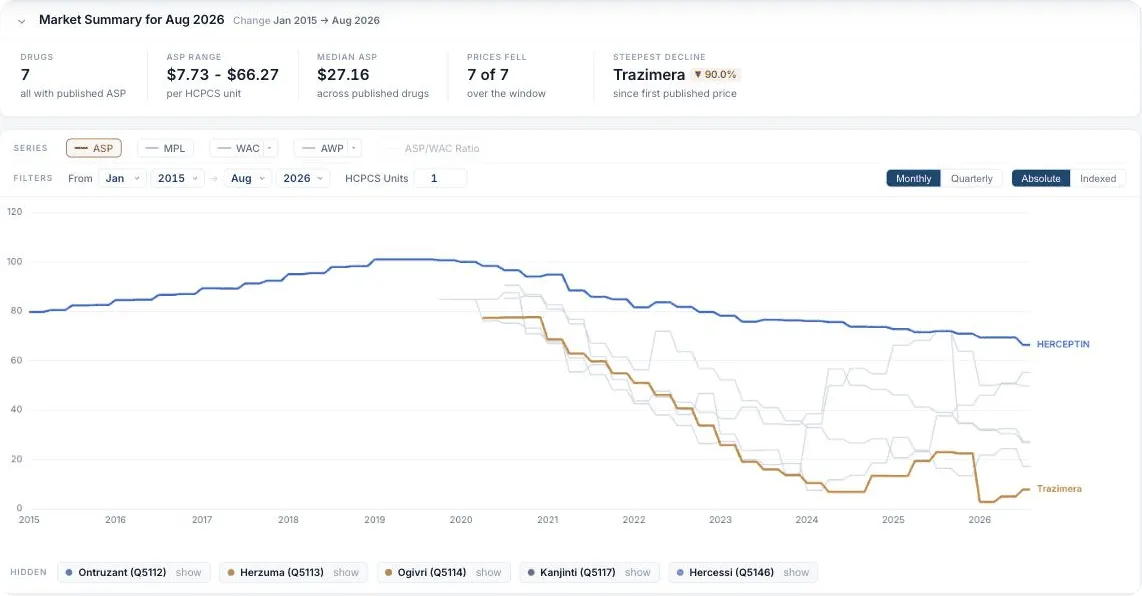
Medicare calculates the payment limit for a biosimilar at either 6% or 8% above the ASP of the biosimilar’s reference drug, so reimbursement tracks the reference product rather than the biosimilar’s own price.
-
Interchangeability and substitution
Only biosimilars approved as interchangeable may be substituted for the reference product at the pharmacy without prescriber involvement, which affects how each product is selected and billed.
The full list
Full biosimilar list by HCPCS code
Our full list of 89 biosimilar drugs and the 96 HCPCS codes they bill under, mapped to the reference products they were approved against. A product with both an IV and a subcutaneous presentation carries a code for each, so it appears once per code. Search, sort, or export the list. Please note that it changes constantly and could contain errors.
| Biosimilar Drug | Biosimilar HCPCS | Active Ingredient | Manufacturer | Reference Drug | Reference HCPCS |
|---|---|---|---|---|---|
| Abrilada | Q5145 | Adalimumab | Pfizer | Humira | J0139 |
| Amjevita | N/A | Adalimumab | Amgen | Humira | J0139 |
| Cyltezo | Q5143 | Adalimumab | Boehringer Ingelheim | Humira | J0139 |
| Hadlima | N/A | Adalimumab | Samsung Bioepis | Humira | J0139 |
| Hulio | Q5140 | Adalimumab | Biocon Biologics | Humira | J0139 |
| Hyrimoz | N/A | Adalimumab | Sandoz | Humira | J0139 |
| Idacio | Q5144 | Adalimumab | Fresenius Kabi | Humira | J0139 |
| Simlandi | Q5142 | Adalimumab | Alvotech USA | Humira | J0139 |
| Yuflyma | Q5141 | Adalimumab | Celltrion USA | Humira | J0139 |
| Yusimry | N/A | Adalimumab | Emerge Bioscience Pte | Humira | J0139 |
| Ahzantive | Q5150 | Aflibercept | Formycon | Eylea | J0178 |
| Enzeevu | Q5149 | Aflibercept | Sandoz | Eylea | J0178 |
| Eydenzelt | Q5170 | Aflibercept | Celltrion | Eylea | J0178 |
| Opuviz | Q5153 | Aflibercept | Samsung Bioepis | Eylea | J0178 |
| Pavblu | Q5147 | Aflibercept | Amgen | Eylea | J0178 |
| Yesafili | Q5155 | Aflibercept | Biocon Biologics | Eylea | J0178 |
| Alymsys | Q5126 | Bevacizumab | Amneal Pharmaceuticals | Avastin | J9035 |
| Avzivi | N/A | Bevacizumab | Bio-Thera Solutions | Avastin | J9035 |
| Jobevne | Q5160 | Bevacizumab | Biocon Biologics | Avastin | J9035 |
| Mvasi | Q5107 | Bevacizumab | Amgen | Avastin | J9035 |
| Vegzelma | Q5129 | Bevacizumab | Celltrion USA | Avastin | J9035 |
| Zirabev | Q5118 | Bevacizumab | Pfizer | Avastin | J9035 |
| Aukelso and Bosaya | Q5161 | Denosumab | Biocon Biologics | Xgeva | J0897 |
| Bildyos and Bilprevda | Q5162 | Denosumab | Organon | Prolia | J0897 |
| Bomyntra and Conexxence | Q5158 | Denosumab | Fresenius Kabi | Xgeva | J0897 |
| Boncresa | Q5171 | Denosumab | Amneal Pharmaceuticals | Prolia | J0897 |
| Enoby and Xtrenbo | Q5167 | Denosumab | Hikma | Prolia | J0897 |
| Jubbonti and Wyost | Q5136 | Denosumab | Sandoz | Prolia | J0897 |
| Ospomyv and Xbryk | Q5159 | Denosumab | Cordavis | Prolia | J0897 |
| Osvyrti and Jubereq | Q5166 | Denosumab | Accord | Xgeva | J0897 |
| Oziltus | Q5165 | Denosumab | Amneal Pharmaceuticals | Prolia | J0897 |
| Ponlimsi | Q5173 | Denosumab | Teva | Prolia | J0897 |
| Stoboclo and Osenvelt | Q5157 | Denosumab | Celltrion USA | Xgeva | J0897 |
| Bkemv | Q5152 | Eculizumab | Amgen | Soliris | J1299 |
| Epysqli | Q5151 | Eculizumab | Teva | Soliris | J1299 |
| Retacrit | Q5105 | Epoetin Alfa | Hospira | Procrit | J0885 |
| Retacrit | Q5106 | Epoetin Alfa | Hospira | Procrit | J0885 |
| Erelzi | N/A | Etanercept | Sandoz | Enbrel | N/A |
| Eticovo | N/A | Etanercept | Samsung Bioepis | Enbrel | N/A |
| Filkri | Q5172 | Filgrastim | Accord | Neupogen | J1442 |
| Nivestym | Q5110 | Filgrastim | Pfizer | Neupogen | J1442 |
| Nypozi | Q5148 | Filgrastim | Tanvex Biopharma USA | Neupogen | J1442 |
| Releuko | Q5125 | Filgrastim | Amneal Pharmaceuticals | Neupogen | J1442 |
| Zarxio | Q5101 | Filgrastim | Sandoz | Neupogen | J1442 |
| Immgolis | N/A | Golimumab | Accord | Simponi | N/A |
| Avsola | Q5121 | Infliximab | Amgen | Remicade | J1745 |
| Inflectra | J1748 | Infliximab | Celltrion USA | Remicade | J1745 |
| Inflectra | Q5103 | Infliximab | Pfizer | Remicade | J1745 |
| Renflexis | Q5104 | Infliximab | Organon | Remicade | J1745 |
| Garzulys | N/A | Insulin Aspart | Emerge Bioscience Pte | Novolog | N/A |
| Kirsty | N/A | Insulin Aspart | Biocon Biologics | Novolog | N/A |
| Merilog | N/A | Insulin Aspart | Sanofi | Novolog | N/A |
| Langlara | N/A | Insulin Glargine | Sunshine Lake Pharma | Lantus | N/A |
| Rezvoglar | N/A | Insulin Glargine | Eli Lilly | Lantus | N/A |
| Semglee | N/A | Insulin Glargine | Biocon Biologics | Lantus | N/A |
| Tyruko | Q5134 | Natalizumab | Sandoz | Tysabri | J2323 |
| Omlyclo | Q5154 | Omalizumab | Celltrion USA | Xolair | J2357 |
| Armlupeg | Q5169 | Pegfilgrastim | Valorum Biologics | Neulasta | J2506 |
| Ennumo | N/A | Pegfilgrastim | Accord | Neulasta | J2506 |
| Fulphila | Q5108 | Pegfilgrastim | Biocon Biologics | Neulasta | J2506 |
| Fylnetra | Q5130 | Pegfilgrastim | Amneal Pharmaceuticals | Neulasta | J2506 |
| Nyvepria | Q5122 | Pegfilgrastim | Pfizer | Neulasta | J2506 |
| Stimufend | Q5127 | Pegfilgrastim | Fresenius Kabi | Neulasta | J2506 |
| Udenyca | Q5111 | Pegfilgrastim | Accord | Neulasta | J2506 |
| Ziextenzo | Q5120 | Pegfilgrastim | Sandoz | Neulasta | J2506 |
| Poherdy | N/A | Pertuzumab | Shanghai Henlius Biotech | Perjeta | N/A |
| Byooviz | Q5124 | Ranibizumab | Samsung Bioepis | Lucentis | J2778 |
| Cimerli | Q5128 | Ranibizumab | Sandoz | Lucentis | J2778 |
| Nufymco | Q5168 | Ranibizumab | Zydus Pharmaceuticals | Lucentis | J2778 |
| Ranluspec | N/A | Ranibizumab | Lupin (Biotech Division) | Lucentis | J2778 |
| Riabni | Q5123 | Rituximab | Amgen | Rituxan | J9312 |
| Ruxience | Q5119 | Rituximab | Pfizer | Rituxan | J9312 |
| Truxima | Q5115 | Rituximab | Teva | Rituxan | J9312 |
| Zimrixby | N/A | Rituximab | Dr. Reddy's Laboratories | Rituxan | J9312 |
| Avtozma | Q0237 | Tocilizumab | Celltrion USA | Actemra | J3262 |
| Avtozma | Q5156 | Tocilizumab | Celltrion USA | Actemra | J3262 |
| Tofidence | Q0234 | Tocilizumab | Biogen | Actemra | J3262 |
| Tofidence | Q5133 | Tocilizumab | Biogen | Actemra | J3262 |
| Tyenne | Q0238 | Tocilizumab | Fresenius Kabi | Actemra | J3262 |
| Tyenne | Q5135 | Tocilizumab | Fresenius Kabi | Actemra | J3262 |
| Hercessi | Q5146 | Trastuzumab | Accord | Herceptin | J9355 |
| Herzuma | Q5113 | Trastuzumab | Teva | Herceptin | J9355 |
| Kanjinti | Q5117 | Trastuzumab | Amgen | Herceptin | J9355 |
| Ogivri | Q5114 | Trastuzumab | Biocon Biologics | Herceptin | J9355 |
| Ontruzant | Q5112 | Trastuzumab | Organon | Herceptin | J9355 |
| Trazimera | Q5116 | Trastuzumab | Pfizer | Herceptin | J9355 |
| Imuldosa | Q5098 | Ustekinumab | Accord | Stelara | J3358 |
| Otulfi | Q9999 | Ustekinumab | Fresenius Kabi | Stelara | J3358 |
| Pyzchiva | Q9996 | Ustekinumab | Samsung Bioepis | Stelara | J3358 |
| Pyzchiva | Q9997 | Ustekinumab | Samsung Bioepis | Stelara | J3358 |
| Selarsdi | Q9998 | Ustekinumab | Teva | Stelara | J3358 |
| Starjemza | Q5164 | Ustekinumab | Hikma | Stelara | J3358 |
| Steqeyma | Q5099 | Ustekinumab | Celltrion USA | Stelara | J3358 |
| Wezlana | Q5137 | Ustekinumab | Nuvaila | Stelara | J3358 |
| Wezlana | Q5138 | Ustekinumab | Nuvaila | Stelara | J3358 |
| Yesintek | Q5100 | Ustekinumab | Biocon Biologics | Stelara | J3358 |
FAQ
Frequently asked questions
What is a biosimilar drug?
A biosimilar is a biological product that is highly similar to an existing FDA-approved reference biologic, with no clinically meaningful differences in safety or efficacy. Think of a biosimilar as a generic for a biologic: because biologics are large, complex molecules derived from living organisms, they can't be copied exactly, so a biosimilar is comparable to, but not an identical copy of, its reference product.
How are biosimilars different from generic drugs?
Generics are exact, chemically synthesized copies of small-molecule brand-name drugs, approved by demonstrating bioequivalence. Biosimilars are large biologic molecules that are highly similar, but not identical, to their reference product. Because biologics are derived from living cells, they can't be copied exactly the way small-molecule generics can, so approval requires comparative analytical and clinical studies rather than a simple bioequivalence demonstration.
What is an interchangeable biosimilar?
An interchangeable biosimilar meets all standard biosimilar requirements and adds switching studies showing that alternating between the biosimilar and the reference product works just as well. Only interchangeable biosimilars may be substituted for the reference product at the pharmacy without prescriber involvement.
How are biosimilars coded for buy and bill?
Biosimilars are coded with HCPCS Q codes that begin with Q5. Each biosimilar receives its own unique Q5 code rather than sharing the reference product’s code, so it can be tracked and reimbursed individually.
How is biosimilar reimbursement calculated?
Medicare calculates the payment limit for a biosimilar at either 6% or 8% above the average sales price (ASP) of the biosimilar’s reference drug, so reimbursement is anchored to the reference product rather than the biosimilar’s own ASP.