NDC Lookup
Search any National Drug Code for its package description, pricing, and aligned HCPCS code.
Explore More →
Look up any drug and get the Medicare allowed amount, the 80/20 split, and the charge to submit at your markup. Free for five drugs a day, no account needed.
Trusted by Leading Healthcare Organizations





















































































Worked Example
One administration of Avastin, from the dose on the order to the charge on the claim line, priced on the current Q4 2026 payment limit.
| Step | How it is worked out | Result |
|---|---|---|
| Get to billing units | ||
| Dose administered | Taken from the order | 400 mg |
| Billing unit | From the descriptor, “Injection, bevacizumab, 10 mg” | 1 unit = 10 mg |
| Billing units | 400 mg ÷ 10 mg per unit | 40 units |
| Price the claim | ||
| Medicare allowed amount | 40 units × $75.492 payment limit | $3,019.68 |
| Medicare pays | 80% of $3,019.68, once the deductible is met | $2,415.74 |
| Patient owes | 20% of $3,019.68, or the secondary payer | $603.94 |
| Charge to submit | $3,019.68 plus your charge master markup, shown here at 15% | $3,472.63 |
This dose divides evenly. One that does not rounds up to the next whole unit, and the remainder is discarded drug billed with JW or JZ.
Each loads into the calculator at the top of the page with the drug, the amount, and the markup already filled in.
400 mg of bevacizumab in 10 mg units, at a 15% markup. CPT administration codes
715 mg of rituximab against a 10 mg unit gives 71.5 units, rounded up to 72. Billing drug wastage (JW and JZ)
The same 400 mg as bevacizumab-awwb. Run it beside J9035. Biosimilar drugs explained
200 mg of pembrolizumab at 1 mg per billing unit. J9271 drug record
300 mg of posaconazole, a small per-unit figure over a large unit count. HCPCS drug code lookup
What You Get
The calculator above prices a claim against what Medicare allows. A subscription adds the published price benchmarks behind that number, plus the coding and analytics around it.
ASP, WAC, and AWP next to the Medicare Payment Limit, so you can price a claim against the published benchmarks rather than the allowed amount alone.
See full pricing dataThe HCPCS descriptor, every aligned NDC package, and the billing-unit conversion that turns a vial into the units on the claim.
See full drug infoMore than ten years of pricing charted and compared across drugs and biosimilars, for budgeting, forecasting, and margin analysis.
Try analytics & reportsWho It's For
The billing team checking a charge, the practice modelling an infusion, the administrator forecasting revenue, and the payer reviewing a rate all work from the same allowed amount.
Work out the charge and the expected reimbursement across units and markup percentages, so the two line up before submission.
Price infusions, injections, and other office-administered drugs across oncology, rheumatology, neurology, ophthalmology, and any specialty that buys and bills.
Run pricing and reimbursement scenarios across units and markup assumptions for budgeting, forecasting, and revenue planning.
Validate and compare charges against the published payment limit across drugs, units, and markup assumptions during reviews and audits.
Troubleshooting
The allowed amount is only one of the things a drug claim depends on. When a remittance comes in under the figure above, it is almost always one of these.
Billing units are not milligrams. A 400 mg dose of a drug defined in 10 mg units is 40 units, not 400. A code defined per dose is 1 unit however much was given.
Look up a code and its billing unit →Payers pay the lesser of your billed charge and the allowed amount, so a charge set at or under the payment limit simply pays at the charge. The difference is never recovered.
When a dose does not use a whole vial, the remainder is billable on its own line with the JW modifier, or attested with JZ when nothing was discarded. Skipping the line forfeits the amount.
Billing drug wastage with JW and JZ →Part B claims carry both. If the NDC submitted is not one aligned to the billed HCPCS code, or is a package no longer listed, the line is denied regardless of the pricing.
NDC lookup →The 80/20 split applies only after the annual Part B deductible is satisfied. Until then those dollars come off the top and are the patient's in full, so Medicare's payment is smaller than 80% of the allowed amount.
Part B payments are cut 2% under sequestration. The reduction comes out of what Medicare pays, not out of the patient coinsurance, so a remittance lands slightly under a plain 80% of the allowed amount.
CMS publishes a limit only alongside a current Average Sales Price. Not-otherwise-classified codes and drugs without one are priced by the local MAC, usually from invoice, so no national figure exists to check against.
HCPCS code applications and approvals →Part B covers drugs administered incident to a physician service. A drug CMS treats as usually self-administered is excluded, and the claim is the patient’s or their Part D plan’s.
Self-administered drug exclusion list →FAQs
What the calculator covers, which benchmarks it runs on, and how it keeps a charge from being under-priced.
Still have a question? Contact usIt turns a drug code into the numbers a claim needs. Pick a HCPCS drug code, enter the billing units administered and the markup your charge master applies, and the calculator returns the Medicare allowed amount for those units, the 80 percent Medicare pays, the 20 percent patient coinsurance, the charge you should submit, and the hospital outpatient (APC) allowed amount for the same code. No account is needed, and you can price five drugs a day free.
The free calculator runs on the Medicare Payment Limit, which is the amount Medicare Part B allows per billing unit, generally ASP plus 6 percent. It also returns the hospital outpatient (APC) limit. ASP, WAC, and AWP are manufacturer-sourced benchmarks that sit behind a subscription, so they appear on the result as a locked row rather than in the free math. With a subscription you can compare the same claim against ASP, WAC, and AWP as well as the allowed amount. See the drug price lookup for how the four benchmarks differ.
Yes. Units and markup are both free inputs, and the result recalculates as you change either one. If you have the dose rather than the unit count, switch the amount field from Units to Dose and the calculator converts it for you against the code's unit definition. J9035 is "Injection, bevacizumab, 10 mg", so a 400 mg dose is 40 units. Part units always round up to the next whole unit, and the leftover is discarded drug you report with the JW or JZ modifier.
Anyone who touches a buy-and-bill claim. Billing and revenue cycle teams use it to check a charge before submission, oncology and specialty practices to model the cost of an infusion or injection, practice administrators and finance teams to run budgeting and forecasting scenarios, and payers and consultants to validate charges against the published payment limit during reviews and audits.
Two of the most common reasons a drug claim pays less than expected are a wrong unit count and a charge submitted below the allowed amount. Payers pay the lesser of the two, so an under-priced charge simply pays at the charge. Seeing the units, the allowed amount, and your charge side by side catches both before the claim leaves. The 80/20 split also tells the front desk what to expect from the patient or a secondary payer. Where a fractional dose leaves discarded drug, bill the remainder with the JW and JZ modifiers. A third reason is a drug that was never payable under the benefit at all, which the Part B coverage check will tell you before you bill it.
You can price five different drugs each day, free. Changing the units, dose, markup, or place of service on a drug you have already loaded never counts as another use, and the count resets every day. A subscription removes the daily limit and adds ASP, WAC, and AWP beside the payment limit on every calculation.
What BuyandBill.com Does
Search any National Drug Code for its package description, pricing, and aligned HCPCS code.
Explore More →Search any HCPCS code for its descriptor, aligned NDC packages, pricing, and reimbursement.
Explore More →Track ASP, WAC, and AWP across 10+ years of history in tabular and graphical formats.
Explore More →Chart two drugs on one graph and compare drugs and biosimilars side by side.
Explore More →Look up a drug and see WAC, AWP, and ASP pricing next to the Medicare Payment Limit, with unit and markup adjustments on every calculation.

The Comparative Report puts ASP, the Medicare payment limit, WAC and AWP for up to 15 drugs on one timeline. Ten-plus years of monthly history, per HCPCS unit.
Included with BuyandBill Pro for $37/month billed annually.
Trastuzumab class, seven products
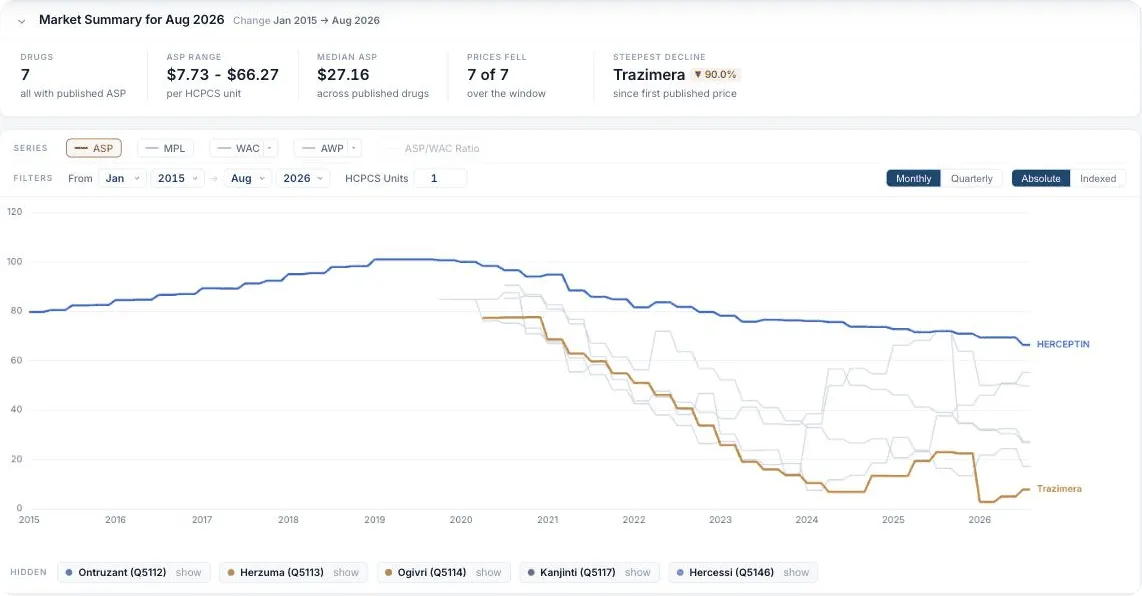
Actual published ASP, Jan 2015 to Aug 2026.