Every drug claim in the United States depends on multiple databases agreeing on one 11-digit National Drug Code (NDC). When those databases disagree, the result can be a denied claim, an underpayment, a drug that cannot be ordered, or a product that is priced or classified incorrectly.
We call these NDC listing errors, and they are more common than most billing teams realize.
NDC data comes from multiple sources, including the FDA, CMS, and commercial drug compendia. Each source is maintained separately and updated on a different schedule. That creates opportunities for the same NDC to be represented differently from one system to another.
This article covers the five most common NDC listing errors, what they look like, and what providers, payers, and manufacturers can do about them.
Where Does NDC Data Come From?
An NDC identifies a specific drug product, labeler, and package. It does not tell you the drug’s price, HCPCS code, or reimbursement amount. That information comes from separate databases.
Public Sources
- FDA NDC Directory — NDC, package, strength, dosage form, and marketing status.
- FDA Orange Book — Approval pathway and therapeutic-equivalence information.
- CMS NDC-HCPCS Crosswalk — NDC-to-HCPCS mappings and billing units for Medicare Part B.
- CMS ASP Files — Quarterly Average Sales Price data used to calculate Medicare payment limits.
- CMS Medicaid Drug Data — Product and pricing information for the Medicaid Drug Rebate Program.
Commercial Drug Compendia
Red Book, Medi-Span, First Databank (FDB), and Gold Standard provide the detailed drug data used by many provider, pharmacy, payer, and claims systems. This can include WAC, AWP, package information, NDC-to-HCPCS mappings, and active/inactive status.
A payer may use a different compendium than a provider. If the two databases disagree, neither side may immediately know there is a problem.
NDC format note NDCs are displayed in a 10-digit format on FDA listings and commonly converted to an 11-digit format for claims. The conversion adds a leading zero to the appropriate segment. A difference between the 10- and 11-digit formats is not necessarily an NDC listing error.
The 5 Most Common NDC Listing Errors
1. Activity Status Errors
An NDC is active in one database but inactive or missing in another.
Example: A newly launched NDC appears in Red Book and Medi-Span but has not yet been added to FDB. A provider using FDB may not be able to find the drug in its ordering or billing system.
Why it matters: The drug exists, but the software effectively treats it as if it doesn’t.
2. Pricing Errors
An NDC has different WAC, AWP, or unit pricing in different databases.
Example: One compendium lists a package WAC of $2,800 while another lists $3,200. A payer using the lower price may calculate a lower reimbursement amount.
Why it matters: Pricing errors often cause underpayments rather than denials, making them harder to detect.
3. NDC-to-HCPCS Alignment Errors
An NDC is mapped to different HCPCS codes across databases, or is missing a HCPCS mapping altogether.
Example: One database maps an NDC to J9924 while CMS maps it to J9925. A provider’s billing system may submit the wrong HCPCS code, causing the claim to reject.
Why it matters: These errors can create hard denials and are particularly common around new drug launches and HCPCS code changes.
4. Approval and Classification Errors
A product’s approval pathway or classification is represented incorrectly in a commercial database.
Example: A product approved under its own NDA is incorrectly treated as a generic downstream.
Why it matters: Brand-versus-generic classification can affect formulary placement, coverage, reimbursement, and contracting. This can be particularly important for products approved through the 505(b)(2) pathway.
5. Package Description Errors
The package size, strength, or units-per-package differ between databases.
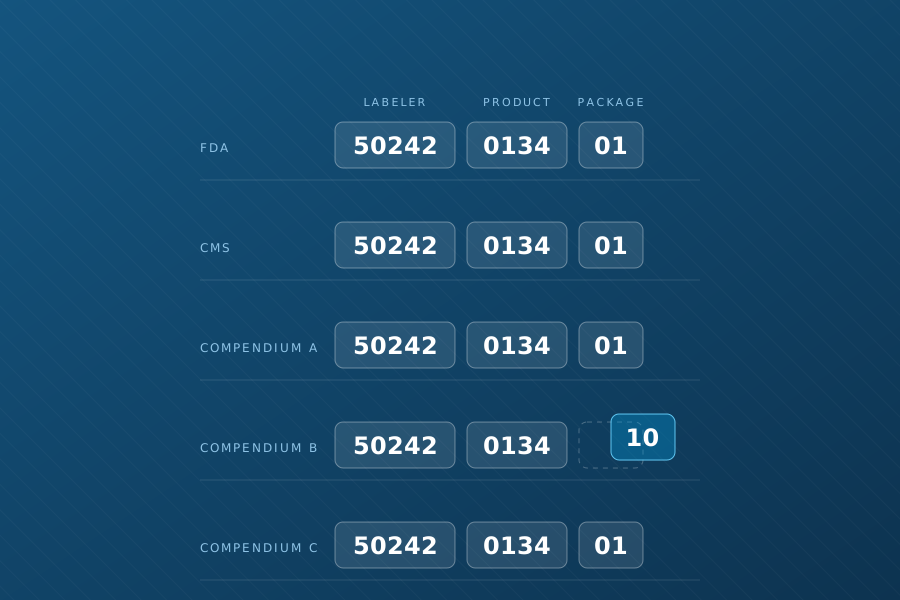
Example: One source lists an NDC as containing 10 units while another lists one. A system using the incorrect quantity can calculate the wrong unit price or billing quantity.
Why it matters: Package information affects pricing, billing units, wastage calculations, and purchasing.
Why Do NDC Listing Errors Happen?
NDC databases do not update simultaneously. The most common reasons for discrepancies are:
- Different update schedules: CMS updates certain files quarterly, while commercial compendia may update much more frequently.
- Manual processing: A change submitted by a manufacturer to one source does not automatically update every other database.
- Different data rules: Each compendium has its own methods for handling pricing, packages, approval information, and HCPCS mappings.
- Different systems: Providers and payers may rely on different databases, so each sees a different version of the same NDC.
In other words, there is no single database that automatically keeps every other drug database synchronized.
How to Find and Fix NDC Listing Errors
Providers
If a claim denies because of an NDC/HCPCS mismatch or a drug does not appear in your billing or ordering system, check the NDC against a second source before assuming the claim is wrong.
Our free NDC Lookup shows the HCPCS code and billing units associated with an NDC in our database. If those differ from your billing system, you may have identified an NDC listing error.
Payers
Periodically compare high-volume Part B drugs against CMS’s NDC-HCPCS crosswalk and ASP files. Comparing important products against a second commercial compendium can also identify pricing and package-data discrepancies.
Manufacturers
Audit your NDCs across the major drug databases when launching a product and after significant packaging, labeling, pricing, or coding changes.
These errors can be especially costly during launch, when utilization is growing and NDC, HCPCS, pricing, and payer data are still making their way into different systems.
If you would like to audit the NDC data for a specific product, contact us to discuss an NDC listing-error audit.
NDC Errors Can Look Like Billing Errors
When a drug claim fails, the first assumption is usually that something is wrong with the claim.
Sometimes the claim is correct.
The problem is the data behind it.
When the NDC, HCPCS code, price, package information, or activity status differs between databases, that discrepancy can work its way into ordering systems, claim edits, and reimbursement.
Before fixing the claim, make sure the underlying NDC data is correct.
Frequently Asked Questions
What is an NDC listing error?
An NDC listing error occurs when information about a National Drug Code is missing or incorrect in one or more drug databases. For example, an NDC might be listed as active in one database but inactive in another, or it might be linked to the wrong HCPCS code or price.
Why do NDC databases have different information?
Different databases are updated at different times and use different rules for organizing drug information. As a result, a new NDC or a change to an existing NDC may appear in one database before it appears in another.
Who can fix an NDC listing error?
The drug manufacturer (labeler) is generally the best place to start. Manufacturers can report corrections and work with the FDA and commercial drug compendia to make sure the information is updated. Providers and payers can identify and report errors, but they generally cannot directly change another organization's database.
How can I check an NDC for errors?
Compare the NDC across multiple sources. Check the FDA NDC Directory for basic product information, the CMS NDC-HCPCS crosswalk for Medicare billing information, and the drug compendium used by your system for pricing and other data.
You can also use our free NDC Lookup to quickly check the HCPCS code and billing units associated with an NDC.